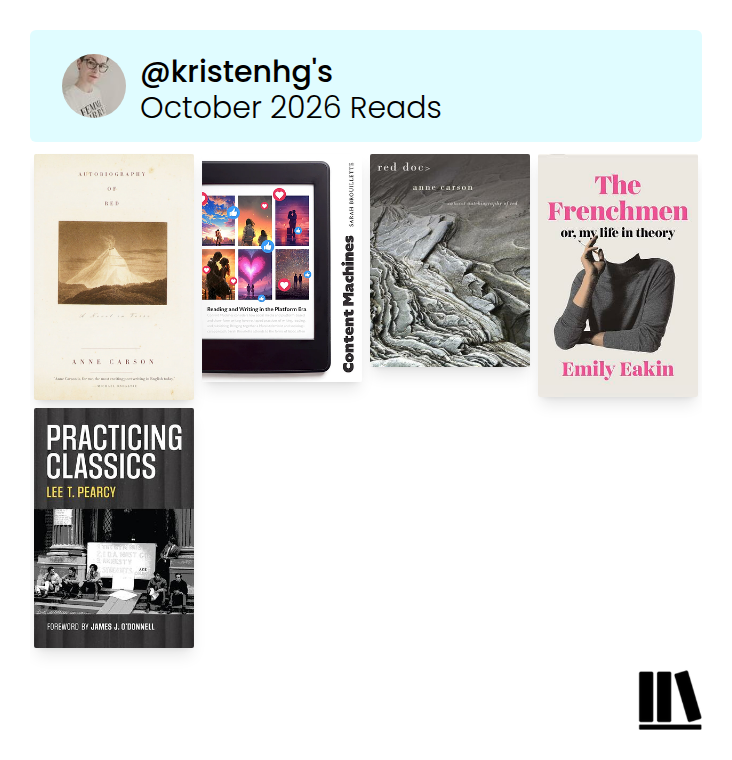
I finished quite a few books this month; most of them were short, but one was very long and dense. One was not great, two were rereads of books I love. Two were for review, none are going to be popular with people who like crime fiction or romantasy. Let’s go!
As always, links to Bookshop.org in this post are affiliate links that help this freelancer stay free. Thanks!
Two of these are easy picks and highly recommended. Anne Carson won the 2026 Nobel Prize for Literature. I love her work; I own several of her books and read everything of hers that the London Review of Books publishes. Dalkey Archive has my number, because they sent out an email after her win offering their edition of her 1986 book Eros the Bittersweet, which was based on her doctoral thesis. Reader, I bought it. Didn’t think twice. I haven’t started reading it yet.
But I did read two Carson books that I have on the shelf and love: Autobiography of Red and its sort-of sequel Red Doc>. They are short and they are poetry, so expect dense imagery but also narrative. The first time you read them, you’ll get through them pretty quickly, but you’ll realize later that you’re still thinking about them and want to read them again. Maybe with a pencil in hand. If you want to read one Carson book in honor of her win, I’d say make it Autobiography of Red.
When I saw that The Frenchmen by Emily Eakin was out, I bought it immediately. I am a huge fan of Roland Barthes, one of the French theorists Eakin writes about in this group biography. I did love the book, but I have quibbles. First, all the other theorists, like Althusser and Foucault, have wild lives. Their lives take up a lot of space in the book. Barthes, on the other hand, was comparatively tame. Even happy. He really loved his theory and wrote about it with more clarity than most of the others (Derrida, looking at you). He was enthusiastic about it and wanted you to come along on his magical mythological ride, not punish you. The wildest thing to happen was his odd death: he was struck by a laundry van while crossing the street. While I wish there was more Barthes in The Frenchmen, I was really glad to learn that he was basically a happy guy.
The other quibble I have is with Eakin’s self-deprecating and even embarrassed autobiographical elements. Like a lot of people, she found theory when she was at university decades ago (I am an admitted latecomer to these guys). Every once in a while, she inserts her perspective on her younger self’s obsession with theory, and she always seems like she’s putting down her naivete as a twenty-something. First of all, theory is great, even if it’s not perfect or fashionable. Second of all, you love what you love when you love it. No embarrassment necessary. It read to me as if an editor somewhere along the line said, “Emily, you can’t just write about these Frenchmen. You need to share yourself with the reader. Put yourself in the story.” So she did. I’ve had these kinds of requests from editors, so maybe I’m projecting. Or maybe I’m attuned to it because of that. Whatever. It’s a good book if you’re into theory and theorists and the French intellectual scene in the mid-twentieth century. BYO black turtleneck.
Okay, now for the two advanced review copies I read last month. I’m not sure which order to tackle these in, since either way I’m going to leave you with a downer.
I’ll start with Practicing Classics by Lee Pearcy. It is a very short memoir of a guy who grew up in the South and found his way, rather improbably, to a life teaching Latin and Greek. I myself am learning Latin for real right now (shoutout to Oxford’s continuing education classes!), and as a person who grew up in a rural area with little exposure to classics or, in my case, medieval English literature, I thought there might be something interesting here. Turns out not so much. It’s the story of how a white guy just kept getting lucky at every turn, and then in the 1980s he stands in solidarity with colleagues against a tyrannical department head and loses his job. But fear not, he lands on his feet at a job he likes even better. The end. I’m sure this memoir has its audience, but it is not me.
Now for Content Machines by Sarah Brouillette. This book is enraging and every writer at every stage of their career should read it immediately and also be enraged. I wanted to pitch a review of this book to outlets, but I was so mad just reading the introduction that I wasn’t sure I could engage meaningfully with the text in a way someplace like Lit Hub or whatever would find useful. If you’re writing and pitching and querying, you know the hellscape that is traditional publishing right now. If you’re self-publishing in genre fiction, like horror or sci-fi or romance, you know that there is a special variety of hellscape for you folks. (Someone rewrite Dante’s Inferno but with publishing all the way down.)
Brouillette does the research and presents the facts, and they are grim. She details how shitty it is for those who try to succeed using Kindle Publishing, how shitty it is for writers on platforms like Wattpad, how shitty it is for audiobooks, and most enragingly, how the feminization of writing and publishing tasks has led to their devaluation.
This book is excellent and well-written and backed up by solid research, which makes it all the more maddening. Definitely read it so we know what we’re up against when we work to change the system.
Leave a Reply